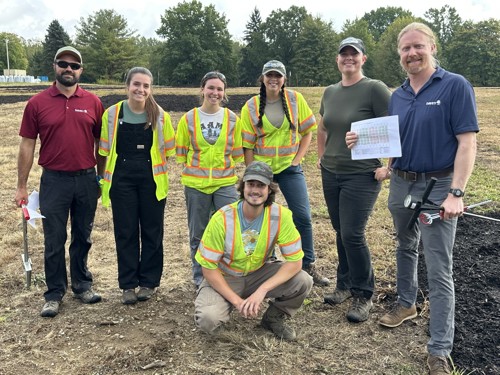

When it comes to tree health and establishment, good soil can make a world of difference. But in urban environments and former construction sites, soil conditions are often less than ideal. At the SEED Campus, Davey Institute researchers will be exploring whether compacted, poor soil – with a low percentage of organic matter and nutrients – can be modified to support tree health.
It’s a unique research set-up that might not have been possible if not for the “stars aligning,” according to Zane Raudenbush, Manager of Research Operations at the Davey Institute.
How the Long-Term Urban Soil Simulation Research Study Came to Be
In 2021-2022, plans for the SEED Campus were beginning to take shape while construction on the third wing of Davey’s corporate headquarters was in full swing. Tree Conservation Specialist Chris Fields-Johnson had an idea for the large amount of subsoil dug up from the building’s foundation: Could it be brought across the street to the SEED Campus and turned into research plots that simulate the urban soil environments Davey teams often work in?
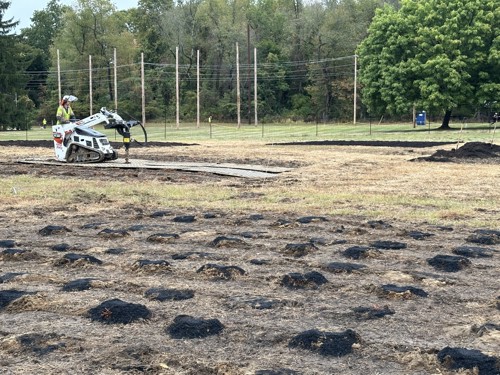
Turns out, it could – and now, the Long-Term Urban Soil Simulation research study is taking shape in the East Research area. There are eight 100x100-foot plots:
- Four plots are undisturbed, with nutrient-rich soil retained from the property’s former function as Oak Knolls Golf Course.
- In the other four, we removed the good soil and replaced it with the subsoil from the corporate third wing construction – and then compacted it using a Sheepsfoot Roller.
According to Raudenbush, there aren’t many studies like this because purposely compacting soil and moving it from one location could be considered cost prohibitive. Because the equipment and crews needed to do this were already on-site, that wasn’t an issue for Davey.
Discovering New Client Solutions
In spring 2026, we’ll plant several different tree species – some that are known to be tolerant to poor soil, and others that are less tolerant. Then, Davey Institute researchers will begin studying several different soil treatments: Arbor Green PRO®, biochar, compost, and vertical mulching, to name a few.
“We’re going to evaluate what we can do to hopefully improve their growth and establishment,” Raudenbush says. “There are different tiers of invasiveness and effort, so we’ll be able to evaluate lots of things: How does tree species affect establishment in poor soil conditions? Are certain treatments only effective for some species?”
Raudenbush expects this study may go on for the better part of a decade – but after a few years, they’ll hopefully begin to gain insights and prescriptions to offer clients.
“Davey is often asked to come in and plant trees in what we would call ‘less than optimal’ soil,” he says. “Or maybe the trees were already planted in these poor soils, and now we’re being called in to see what we can do to improve them. This study might teach us prescriptions that work with different trees and soil types.”