

Trees do not always reveal structural problems on the surface. Detecting tree decay and conducting accurate tree risk assessments require a combination of field techniques, diagnostic tools and professional expertise to identify hidden issues before they become visible.
During the SEED Campus' Lab to Landscape series, Davey's quarterly series connecting employees with research from the Davey Institute, RJ Laverne, manager of education and training, showed employees how to combine experience, field assessment techniques and advanced technology to evaluate tree decay and assess tree risk.
How Can Sound Reveal Hidden Tree Decay?
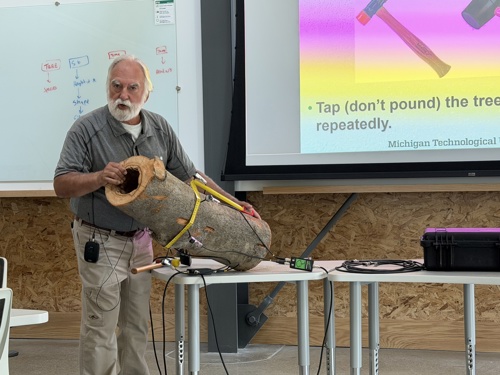
One of the first diagnostic techniques Laverne discussed was sounding, which involves tapping a tree with a mallet and listening for changes in pitch and resonance. Similar to how people 'thump' watermelons to determine if they are ripe, arborists use sound to gather clues about conditions hidden beneath the surface.
A consistent, higher-pitched sound often indicates solid wood, while lower-pitched sounds can suggest internal decay or cavities. This easy-to-do technique remains a valuable tool for arborists because it can reveal issues that aren't always visible. Learning how to sound a tree can be the difference between a safe day on the job and a serious accident or fatal injury.
What Tools Help Arborists Further Investigate Decay?
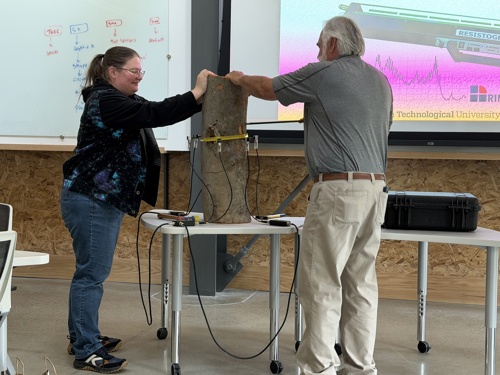
Arborists can use additional tools, such as increment borers and resistance drills, to evaluate internal wood condition. Increment borers extract a thin core of wood that reveals the condition of the interior of the tree. Resistance drills measure how much force is required to penetrate wood, creating a graph that helps identify areas of decay within the tree.
For more advanced decay investigations, arborists may use sonic tomography tools such as Arborsonic. These systems use sound waves to create a visual representation of a tree’s internal condition, helping identify areas of solid wood, decay and internal cavities without drilling into the tree.
While advanced technologies, such as Arborsonic, can provide detailed insight into a tree’s internal condition, they don’t replace the fundamentals. Simple tools and techniques, like sounding, can provide valuable information that helps arborists make safer, more informed decisions in the field.
How Does Decay Detection Support Tree Risk Assessments?
Laverne shared several case studies demonstrating how decay detection tools support informed management decisions. At the Akron Zoo, a sounding assessment revealed signs of hidden decay in an oak tree that showed few outward symptoms. Additional testing confirmed extensive internal decay, helping managers reduce risk and plan for the tree's removal before failure could occur.
Other examples showed how internal decay can develop in critical structural areas that aren't visible from the outside. These findings reinforced the value of combining visual inspections with diagnostic tools to gain a more complete understanding of the situation.
How Arborists Turn Research Into Better Decisions
While decay detection tools can reveal what's happening inside a tree, determining the appropriate course of action requires professional judgment.
The presence of decay does not automatically warrant tree removal. Arborists must also consider factors such as species, tree structure, site conditions, potential targets and the extent of decay.
By combining science, technology and experience, arborists can make well-informed decisions that balance public safety, tree preservation and long-term landscape management.


