
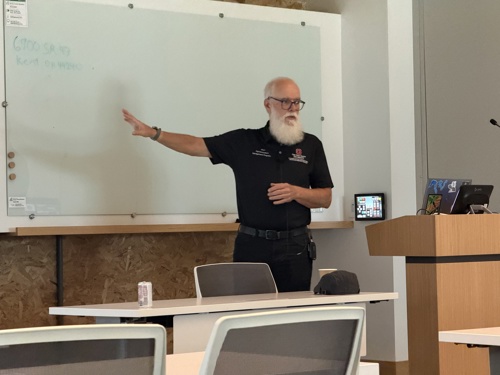
At the SEED Campus, we connect our employees with leading researchers and industry experts every day. Last week, we were honored to host Dr. Larry Phelan, professor at The Ohio State University's Department of Entomology, for the lecture, "Garden Plots and Steel Plants – Divergent Legacies Recorded in Cleveland's Soils."
Phelan's research explored how Cleveland's industrial and agricultural histories continue to shape the health of urban soils today and what those findings can teach us about land stewardship and soil management.
How Has Cleveland's Industrial and Agricultural History Affected Soil Health?
Cleveland was once one of the nation's leading manufacturing centers, with steel mills, refineries and other industries driving economic growth throughout the 20th century. While that industry activity helped shape the city, it also left behind environmental impacts that can still be detected in soils today.
He shared Cleveland's rich history, including the development of one of the country's earliest and most influential youth gardening programs. Beginning in the early 1900s, students and residents cultivated gardens across the city, creating a legacy of urban agriculture that continues through community gardens, urban farms, and neighborhood greening efforts today.
Understanding Cleveland's Urban Soil Ecology
The contrast between Cleveland's industrial plots and urban agriculture raised the question – how can we understand Cleveland's soil ecology? Phelan and his team compared soils from Cleveland Metroparks, vacant lots, urban farms and gardens, and rural organic farms. Their research examined a variety of soil characteristics, including organic matter, nutrient availability, and contamination levels.
The study focused on the importance of organic matter. Urban farms and gardens contained higher levels of organic matter than vacant lots, resulting in improved soil quality and function. The research also found lower concentrations of several contaminants at sites that had been actively managed with compost and other organic solutions. This highlighted the potential for urban agriculture to contribute to healthier soil systems.
For attendees, the lecture provided valuable insight – soil management matters. Urban soils are not fixed, and management practices can play an important role in shaping soil function and quality over time.
Connecting Employees with Research Through the SEED Campus
Lectures and learning opportunities like this are available to employees across the country throughout the year. Our continued efforts toward leadership, stewardship, and expertise are happening at the SEED Campus, allowing our employees to bring science-based knowledge and solutions to our clients and communities.